Remix Making Art and Commerce Thrive in the Hybrid Economy Review
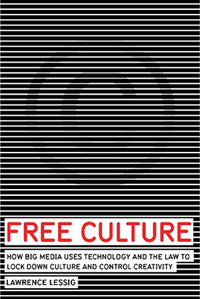 Original cover | |
| Author | Lawrence Lessig |
|---|---|
| Country | U.s. |
| Language | English |
| Genre | Non-fiction |
| Publisher | Penguin Press |
| Publication date | 2004 |
| Media blazon | Impress (Hardcover and Paperback) |
| ISBN | 978-1-59420-006-nine |
| Preceded by | The Hereafter of Ideas |
| Followed past | Code: Version ii.0 |
Free Culture: How Large Media Uses Applied science and the Law to Lock Downwardly Civilisation and Command Creativity (published in paperback as Free Culture: The Nature and Futurity of Creativity ) is a 2004 volume past law professor Lawrence Lessig that was released on the Internet under the Artistic Commons Attribution/Non-commercial license on March 25, 2004.
This book documents how copyright power has expanded essentially since 1974 in 5 disquisitional dimensions:
- duration (from 32 to 95 years),
- scope (from publishers to virtually everyone),
- attain (to every view on a estimator),
- control (including "derivative works" defined so broadly that virtually any new content could be sued past some copyright holder as a "derivative work" of something), and
- concentration and integration of the media manufacture.
It also documents how this industry has successfully used the legal system to limit competition to the major media corporations through legal action against:
- College students for shut to $100 billion, because their improvements of search engines made information technology easier for people in a university intranet to detect copyrighted music placed by others in their "public" folder.
- Lawyers who advised MP3.com that they had reasonable grounds to believe streaming an MP3 uploaded past a customer only to computers that the customer has logged-in on for the service is legal, and
- Venture capitalists who funded Napster.
The issue is a legal and economic environment that stifles "the Progress of Science and useful Arts", exactly the opposite of the purpose cited in the U.s. Constitution. It may not be possible today to produce another Mickey Mouse, because many of its early cartoon themes might be considered "derivative works" of some existing copyrighted material (equally indicated in the subtitle to the hardback edition and in numerous examples in this volume).
Summary [edit]
This volume is an outgrowth of the U.S. Supreme Court decision in Eldred v. Ashcroft, which Lessig lost. Article I, Section eight, Clause 8 of the U.S. Constitution says, "The Congress shall have Ability... to promote the Progress of Science and useful Arts, by securing for limited Times to Authors and Inventors the exclusive Right to their respective Writings and Discoveries." Several times in the past century, Congress has extended the copyright law in several ways. I way was to extend the term "on the installment plan".[1] Another was to broaden the scope to include not simply copying but creating "derivative works". This latter broadening is so ambiguous that it provides a foundation for massive abuse of power past companies holding large copyright portfolios. For example, the Recording Manufacture Clan of America sued a freshman at Rensselaer Polytechnic Institute (RPI) for $12,000 for improving a search engine used just inside RPI.[2] Lessig cites another case where Fox demanded $10,000 for the rights to use a 4.five second video clip with The Simpsons playing on a television in a corner of a scene in a documentary.[3] Anyone producing a collage of video clips tin potentially exist similarly sued on the grounds the collage is a "derivative piece of work" of something copyrighted or that the collage contains a shot that is copyrighted. Lessig argues that this substantially limits the growth of creative arts and culture, in violation of the U.s. Constitution; the Supreme Court ruled that Congress has the constitutional authority to properly balance competing interests on cases like this.
In the preface of Free Civilisation, Lessig compares this volume with a previous book of his, Lawmaking and Other Laws of Cyberspace, which propounded that software has the effect of police force. Free Culture's message is unlike, Lessig writes, because it is "about the effect of the Internet to a part of our tradition that is much more fundamental, and, as hard as this is for a geek-wanna-exist to admit, much more than important." (pg. xiv)
Professor Lessig analyzes the tension that exists between the concepts of piracy and property in the intellectual property realm in the context of what he calls the present "depressingly compromised procedure of making police" that has been captured in nigh nations past multinational corporations that are interested in the accumulation of uppercase and non the free substitution of ideas.
The book too chronicles his prosecution of Eldred and his attempt to develop the Eldred Act, also known every bit the Public Domain Enhancement Act or the Copyright Deregulation Act.
Lessig concludes his book by suggesting that as society evolves into an information society at that place is a choice to exist made to decide if that society is to exist complimentary or feudal in nature. In his afterword he suggests that free software pioneer Richard Stallman and the Free Software Foundation model of making content bachelor is non against the capitalist approach that has allowed such corporate models as Westlaw and LexisNexis to have subscribers to pay for materials that are essentially in the public domain just with underlying licenses like those created by his organization Creative Commons.
He also argues for the creation of shorter renewable periods of copyright and a limitation on derivative rights, such as limiting a publisher's ability to stop the publication of copies of an writer's book on the cyberspace for not-commercial purposes or create a compulsory licensing scheme to ensure that creators obtain straight royalties for their works based upon their usage statistics and some kind of taxation scheme such equally suggested by professor William Fisher of Harvard Law Schoolhouse[iv] that is similar to a longstanding proposal of Richard Stallman.
Themes [edit]
Introduction and Identification of Cultural Shift [edit]
Lessig defines "Complimentary Civilization" not as "gratis" as in "Free Beer", merely "gratis" every bit in "free voice communication".[5] A free civilisation supports and protects its creators and innovators directly and indirectly. It directly supports creators and innovators by granting intellectual property rights. Information technology indirectly supports them by ensuring that follow-on creators and innovators remain as free as possible from the creators of the past by limiting how all-encompassing intellectual property rights are. A "permissions culture" is the opposite of a free civilization; in a permissions culture, creators and innovators are just able to create and innovate with the permission of creators of the by – whether they be powerful creators or not.[six]
Lessig presents two examples that provide some insight into the nature of these dueling cultures. In the first, an example of "gratis civilisation", he describes how aircraft operators did not have to abide by an erstwhile police that country owners also owned the air above the property and thus could foreclose overflight.[vii] In the second, an instance of a "permissions culture", he describes how David Sarnoff, president of RCA, managed to persuade the government to delay the deployment of the rival wideband FM radio, invented by Edwin Howard Armstrong. He describes this as an example of how the inventor of a new invention can exist forced to request "permission" from a previous inventor.[viii]
The disparate features of a free civilization and a permissions culture affect how culture is made. In a gratuitous culture, innovators are able to create — and build upon past creations — without the worry of infringing upon intellectual property rights. In a permissions civilization, innovators must offset asking "permission" from past creators in order to build upon or modify by creations.[9] Oftentimes, the innovator must pay the past creator in order to obtain the permission needed to proceed. If the by creator refuses to grant permission to the innovator, the by creator may appeal to the government to enforce their intellectual belongings rights. Typically, intellectual property rights protect culture that is produced and sold, or made to be sold. This blazon of culture is commercial culture,[10] and the focus of the law is typically on commercial creativity rather than non-commercial action. Initially, the law, "protected the incentives of creators by granting them exclusive rights to their artistic work, and so that they could sell those sectional rights in a commercial market."[11] This protection has become far more extensive, every bit is evinced in the Armstrong/RCA example.
Lessig argues that we are fast becoming a permissions civilisation, though he sees the internet equally a modern-day Armstrong: it challenges the traditional innovator and seeks to break gratuitous of any permissions or strict regulations.[12] The cyberspace can provide a vastly more than vibrant and competitive innovation civilisation, and this is troublesome for any large corporations that have invested in fortifying their intellectual belongings rights: "Corporations threatened by the potential of the internet to change the way both commercial and noncommercial culture are made and shared take united to induce lawmakers to use the law to protect them."[xiii] The net has facilitated the mass production of culture, both commercial and noncommercial. Corporations that had traditionally controlled this production have reacted past pressuring legislators to modify the laws to protect their interests. The protection that these corporations seek is not protection for the creators, but rather protection against sure forms of business that directly threaten them.[14] Lessig's worry is that intellectual property rights will not be protecting the right sort of belongings, but volition instead come to protect individual interests in a controlling way. He writes that the Commencement Amendment protects creators against state control and copyright law, when properly balanced, protects creators against private control. Expansive intellectual property rights stands to dramatically increase all regulations on creativity in America, stifling innovation by requiring innovators to request permission prior to their creative piece of work.
Costless Civilisation covers the themes of Piracy and Holding. Lessig writes at the end of the Preface, "... the free civilization that I defend in this volume is a residue between anarchy and control. A costless civilisation, similar a costless market place, is filled with property. It is filled with rules of property and contract that become enforced by the state. But just every bit a costless marketplace is perverted if its property becomes feudal, so as well can a costless civilisation be queered by extremism in the property rights that define it."[15]
Piracy [edit]
"How free is this culture?"[16] Co-ordinate to Lessig, ours has been but is decreasingly a gratuitous culture. Free cultures leave content open up for expansion by others. Purportedly, this is non a new practice, only one that is increasingly challenged, more often than not for economic reasons past creators and manufacture. The conflict or "war against piracy"[17] emerges from efforts to regulate creative property in society to delimit the apply of creative holding without permission. As Lessig sees it, "the law's role is less and less to back up creativity, and more and more to protect certain industries confronting competition."[xviii]
This new role of police is meant to protect copyright owners from 'pirates' who share their content for free, finer 'robbing' the creator of any profit.[19] Lessig acknowledges piracy is wrong and deserving of penalty, even so he is concerned the concept, every bit it appears in the context of 'cyberspace piracy', has been used inappropriately. This problematic conception follows a sure chain of reasoning: creative work has value; when an individual uses, takes or builds upon someone else'due south creative work they are appropriating something of value from the creator. If someone appropriates something of value from a creator without the creator's expressed permission, then that someone is 'pirating' the creator'south work, and this is wrong.[xx] Rochelle Dreyfuss, an NYU Professor of Law, has termed this conception of piracy the "if value, then right" theory of creative property — namely, "if there is value, then someone must have a right to that value."[21]
Showtime defining and and so pointedly critiquing a prevalent "if value, then correct" notion of creative property,[22] Lessig emphasizes that American law recognizes intellectual property every bit an instrument.[23] Lessig points out that if "if value, then right" is correct, so picture, recorded music, radio, and cable Tv each is built on a history of piracy.[24] Lessig details the history of these four "pirates"[25] as examples of how pervasive has been the practice of making use of others' creative property without permission. Chiefly, Lessig points out, throughout man history, "every guild has left a certain bit of its culture free for the taking."[26] This costless culture has historically been deliberate, and widely appreciated. In fact, "creators here and everywhere are always and at all times building upon the inventiveness that went before and that surrounds them now."[27]
Lessig goes on to suggest that the advent of the Internet has changed our culture, and along with it the expectation and credence of creative piracy. In detail, the internet has brought virtually a war against piracy. At the middle of the heat is a question about the reach, do good, and burden of copyright law. The cyberspace is a bold claiming to the "natural limit to the accomplish of the constabulary",[28] and therein lies the quandary. The presence of the cyberspace instigates and fans the flames of the piracy state of war by virtue of its inherent ability to very apace and indiscriminately spread content.
Ultimately, Lessig leaves us to deliberate "fifty-fifty if some piracy is evidently incorrect, non all piracy is."[29] Finding the balance is, has been, and needs to continue to be the process of U.S. police force;[30] internet use, as exemplified by peer-to-peer (p2p) file sharing pushes the envelope.
For centuries, copyright holders have complained about "piracy". In 1996, the American Social club of Composers, Authors and Publishers (ASCAP) sued "the Girl Scouts for failing to pay for the songs that girls sang around Girl Scout campfires."[31] The accommodate was a public relations disaster for ASCAP, and they dropped the suit. However, the police still remains: If you sing a copyrighted song in public, you lot are legally required to pay the copyright holder.
Copyright constabulary has as well been extended to threaten the very creativity that is a central value of our social club, burdening it "with insanely complex and vague rules and with the threat of obscenely severe penalties." Copyright law at its birth just protected inappropriate copying. Today information technology also covers
"building upon or transforming that piece of work... [W]hen the police force regulates as broadly and obscurely as it does, the extension matters a lot. The brunt of this police force now vastly outweighs any original benefit... [T]he law's role is less and less to support creativity, and more and more to protect certain industries against competition."[32]
Property [edit]
Lessig explains that copyright is a kind of belongings, but that it is an odd kind of property for which the term can sometimes be misleading—the difference between taking a table and taking a practiced idea, for example, is difficult to encounter under the term 'holding'.[33] Every bit late every bit 1774, publishers believed a copyright was forever. A copyright at that time was more limited than it is today, but prohibiting others from reprinting a volume; it did non cover, equally today, other rights over performance, derivative works, etc.[34] Mod technology allows people to re-create or cut and paste video clips in creative new ways to produce fine art, entertainment, and new modes of expression and communication that didn't exist before. The resulting potential for media literacy could help ordinary people not only communicate their concerns better but also make it easier for them to understand when they are beingness suckered into things not in their interests. However, current copyright police effectively restricts the use of this to very wealthy individuals and corporations for two reasons: (1) the vagueness of "off-white use". (2) The costs of negotiating legal rights for the creative reuse of content are astronomically high. "You either pay a lawyer to defend your fair use rights or pay a lawyer to track downwards permissions so you don't have to rely on fair use rights."[35]
Drawing on an argument Lessig made in Code and Other Laws of Cyberspace he applies the model of four different modalities of regulation that support or weaken a given correct or regulation. The four ways of regulation are law, market, architecture and norms.[36] These four modalities constrain the target group or individual in different means, and police tends to function as an umbrella over the other methods. These constraints can be inverse, also a restriction imposed by one constraint may allow freedoms from some other. Lessig maintains that before the internet these constraints remained in balance with each other in regulating copying of artistic works.[37]
However, government back up of established companies with an older form of doing business concern would preclude innovation induced contest and overall progress. Lessig says it best ' information technology is the special duty of policy makers to guarantee that that protection not become a deterrent to progress'[38] He specifies that his argument is not nigh justification of protection of copyrights but the furnishings of changing the law regarding copyright in the face of the Internet. In this regard he brings the example of the unforeseen furnishings on the environment of using the chemic pesticide Dichloro-diphenyl-trichloroethane despite its initial hope for commercial agriculture. Post-obit this allusion he calls for an almost environmentalist awareness for the future of the creative environment.[39]
Copyright has changed from covering merely books, maps and charts to whatsoever work today that has a tangible form including music to architecture and drama and software. Today, it gives the copyright holder the exclusive right to publish the work and control over whatever copies of the work too equally any derivative piece of work. Additionally, there is no requirement to register a work to become a copyright; information technology is automatic, whether or non a copy is made bachelor for others to copy. Copyright law does not distinguish between transformative utilize of a piece of work and duplication or piracy. The alter in copyright scope today ways law regulates publishers, users, and authors, simply because they are all capable of making copies. Earlier the internet, copies of any work were the trigger for copyright law, only Lessig raises the point of whether copies should always be the trigger, peculiarly when considering the mode digital media sharing works.[forty]
In 1831, the term of copyright increased from a maximum of 28 years to a maximum of 42; in 1909 the renewal term was extended from 14 years to 28. Offset in 1962, the term of existing copyright was extended eleven times in the last 40 years. Subsequently 1976, whatever works created were subject to only 1 term of copyright, the maximum term, which was the life of the author plus l years, or seventy 5 years for corporations. According to Lessig, the public domain becomes orphaned by these changes to copyright law. In the past thirty years the average term has tripled and has gone from virtually 33 years to 95.[41]
At that place are uses of copyrighted material that may involve copying that do not invoke copyright police force; these are deemed off-white uses. Fair utilize constabulary denies the possessor any sectional correct over such fair uses for public policy. The cyberspace shifts the use of digital creative property, to one that is now regulated under copyright police force. At that place is almost no utilize that is presumptively unregulated.[42]
Relatively recent changes in engineering and copyright law take dramatically expanded the impact of copyright in five different dimensions:
- The duration increased from an average of 32.2 years to 95 (for copyrights owned by corporations) between 1974 and 2004,[43] and it may however be extended farther, in violation of the constitutional requirement that the exclusive rights exist "for limited times".
- The telescopic has increased from regulating only publishers to now regulating only about everyone.[44]
- The reach has expanded, because computers make copies with every view, and these copies are presumptively regulated.[45]
- The control the copyright holder has over utilise has expanded dramatically, using the Digital Millennium Copyright Deed to prosecute people with software that could defeat the limits built into the code used to distribute the production. The latter may limit how many times a person can view the material, whether copy and paste is allowed, whether and how much can be printed, and whether the copy tin can be loaned or given to anyone else.[46]
- Increases in the concentration and integration [of] media ownership provides unprecedented control over political discourse and the evolution of civilisation. "[F]ive companies command 85 pct of our media sources... [F]our companies control xc percent of the nation's radio advert revenues... [T]en companies control half of the nation's [newspapers]... [T]en flick studios receive 99 percent of all film acquirement. The ten largest cablevision companies business relationship for 85 percent of all cable revenue."[47]
Lessig argues that some of these changes benefited society equally a whole. However, the combined effects of the changes in these 5 dimensions has been to restrict rather than promote the Progress of Science and useful Arts, in apparent violation of the constitutional justification for copyright constabulary. The negative impact on inventiveness can exist seen in numerous examples throughout this volume. A stark example of its impact on political discourse is the refusal by the major TV networks to run ads critical of the Bush administration's claims of Saddam Hussein'southward weapons of mass destruction during the period prior to the U.S. invasion of Iraq in 2003, enforced by Supreme Court decisions that give stations the right to choose what they volition and will not run.[48] Lessig claims this kind of surround is not democratic,[49] and at no point in our history have we had fewer "legal correct[s] to control more of the development of our culture than at present."[50]
Outline [edit]
The following summarizes the dissimilar sections of the book.
Preface [edit]
Lessig insists that the time to come of our guild is being threatened past contempo changes in U.s.a. law and assistants, including decisions by the United states of america Federal Communications Commission that allow increased Concentration of media buying. Lessig claims to defend a free culture that is balanced between command — a culture that has belongings, rules, and contracts pertaining to holding that are enforced by the country — and chaos — a civilisation that can abound and thrive when others are immune to use and build upon the holding of others. However, this civilisation tin go puzzling and perplexing when the extremism about belongings rights begins to mimic the feudal property of a costless market.[51]
Introduction [edit]
Lessig provides ii examples that portray the divergence between a free culture and a permissions culture — two themes that will develop throughout the book. (Encounter Introduction and Identification of cultural Shift)
Chapter 1. Creators [edit]
Lessig devotes the offset chapter to defining creators as 'copycats' who borrow and "build upon the creativity that went earlier and that surrounds them now... partially washed without permission and without compensating the original creator."[52] Throughout the affiliate Lessig develops on a theme that "all cultures are gratis to some caste,"[53] by expounding on fundamental examples from the American and Japanese cultures, namely Disney and doujinshi comics, respectively.
The showtime commercial success of Mickey Mouse came with Steamboat Willie, released in 1928. In office, information technology parodied the silent film Steamboat Bill, Jr., released before that year by Buster Keaton. Under current US law, Steamboat Willie might be challenged for copyright violation as a "derivative piece of work" of Steamboat Bill, Jr. Still, nether copyright laws in 1928, this type of cultural production was unproblematic. This change has had a chilling upshot on creativity, serving to reduce competition to the established media companies, as suggested by the subtitle to the original hardback edition of Complimentary Culture.
Similarly, in the vigorous Japanese comic market place, where "Some 40 per centum of publications are comics, and 30 percent of publication revenue derives from comics",[54] one main driving force is 'doujinshi', which is a kind of copycat technique. However, to authorize as doujinshi, "the creative person must make a contribution to the fine art he copies... Doujinshi are plainly 'derivative works.'" The doujinshi artists about never go the permission of those who own the works they alter, though their work is seen to contribute to the overall cultural production.
This illegal, though culturally significant, market flourishes in Japan considering information technology helps the mainstream comic creators. The mainstream market flourishes besides despite the derivative doujinshi market. Fighting this burgeoning illegal market would spell trouble for the mainstream market as well; these two systems for creating have learned to live somewhat harmoniously with one another, to each other's benefit.[55]
Lessig concludes with a thought that "ours was a free culture [that] is becoming much less and then."[56] So, would the U.s.a. take a more vibrant industry in creating comics if the police were not used every bit often here to punish and intimidate small competitors to the large business concern producing comics?
Chapter 2. "Mere Copyists" [edit]
Affiliate two is a give-and-take about the influence of applied science on civilisation, and the legal environs that impacts its attain. Lessig recounts George Eastman's invention of Kodak as a engineering that advanced the invention of photography, and brought about meaning social modify by giving the average denizen admission to what began as an aristocracy course of expression. Lessig traces the simultaneous legal surroundings that permitted its genius: Given the claiming of deciding whether photographers would need to get permission before taking aim, the legal system decided "in favor of the pirates... Freedom was the default."[57]
Lessig presses to suggest that, had the legal atmosphere been different, "nothing like the growth in a democratic technology of expression would have been realized."[58] Republic of expression is a main theme for this chapter, as Lessig examines various examples of the technologies that are developed to promote then-chosen "media literacy", the understanding and agile utilize of media for learning, living, and communicating in the xx-first century;[59] he describes media literacy as a tool for empowering minds and reversing the digital divide.[60]
The Internet is introduced as a prime example of a technology that develops the civilisation. For Lessig, the Internet is a "mix of captured images, sound, and commentary [that] can exist widely spread practically instantaneously."[61] With e-mail service and blogging, the Net creates a dimension for democracy of speech that is widespread and far-reaching. Lessig's lament is that the freedom that the Net and similar technologies offer is increasingly challenged by the restrictions that are placed upon them through laws that "close down that technology."[62]
Chapter 3. Catalogs [edit]
In chapter iii, Lessing shares an account of Jesse Jordan, a 2002 freshman at Rensselaer Polytechnic Constitute (RPI) who fabricated a significant contribution to the free civilization debate through tinkering to develop a search engine which indexed pictures, research, notes, flick clips and a multifariousness of other RPI network materials. When the Recording Industry Association of America (RIAA) sued Jesse (and iii other students) for piracy, forcing him into a settlement that price him all of his $12,000 savings, Jesse became an activist for free culture.
Chapter 4. "Pirates" [edit]
In chapter 4 Lessig advises that "the history of the content manufacture is a history of piracy. Every important sector of the 'large media' today — film, records, radio, and cablevision Idiot box — was built-in of a kind of piracy and so defined."[63] This includes the film industry of Hollywood who used piracy in club to escape the controls of Thomas Edison's patents.[64] Similarly, the record manufacture grew out of piracy due to a loophole in the law permitting composers exclusivity to copies of their music and its public performance, just not over reproduction via the new phonograph and thespian piano technologies.[65] Radio besides grew out of piracy since the radio industry is non required to compensate recording artists for playing their works. As such, "the law gives the radio station the correct to have something for nothing,"[66] though radio is required to pay the composer. Cablevision Boob tube is notwithstanding another example of big media that grew out of piracy. For decades, cable companies were not required to pay for their circulate content. Equally in the case with recorded music, police force ultimately settled this score by setting a toll at which cable companies would pay copyright holders for their content.
Co-ordinate to Lessig, "every industry afflicted by copyright today is the product and casher of a certain kind of piracy... Every generation welcomes the pirates from the last... until now.[67]
Affiliate 5. "Piracy" [edit]
Lessig contextualizes piracy, noting that "even if some piracy is plainly wrong, non all 'piracy' is... Many kinds of 'piracy' are useful and productive... Neither our tradition nor whatever tradition has always banned all 'piracy'."[68]
Lessig compares the examples of piracy that were previously treated:
| Instance | Whose value was 'pirated' | Response of the courts | Response of Congress |
|---|---|---|---|
| Recordings | Composers | No protection | Statutory license |
| Radio | Recording artists | N/A | Nothing |
| Cablevision Idiot box | Broadcasters | No protection | Statutory license |
| VCR | Film creators | No protection | Nothing |
[69]
Bringing the discussion to an up-to-date example, Lessig gives an overview of Napster peer-to-peer (p2p) sharing and outlines benefits and harms of this kind of piracy through sharing. He cautions that laws should be tempered co-ordinate to how much do good and how harm such sharing might cause. According to Lessig, [t]he question is a matter of residuum. The law should seek that rest... [70]
Lessig emphasizes the role of copyright police, pointing out that every bit it stands, copyright police impacts all kinds of piracy, and hence is a office of the piracy state of war that challenges free civilization. On the 1 hand, copyright supporters indiscriminately recognize cultural content as sharing the same attributes as tangible property. On the other hand, creators shun the notion of having their intellectual holding at the disposal of pirates, and and then agree to delimit commonality through strict copyright laws. Ultimately, Lessig calls for changes in United states copyright police force that balance the support of intellectual holding with cultural freedom.[71]
"Property" [edit]
A copyright is an odd kind of property, considering it limits free employ of ideas and expression. Chapters 6–9 offer 4 stories to help illustrate what it means to say that a copyright is belongings.[72]
Affiliate 6. Founders [edit]
In the majority of European countries, copyright law began with the efforts of spiritual and temporal authorities to control the product of printers.[73] This was ofttimes washed by granting monopolies. "Henry VIII granted a patent to print the bible".[74] In England, the Crown's do of handing out monopolies became quite unpopular and was 1 of the bug that motivated the English Civil War of 1642–1651.[75]
As late as 1774, publishers believed a copyright was forever. This was in spite of the fact that "[t]he Statute of Anne [of 1710 tried to limit this by declaring] that all published works would get a copyright term of 14 years, renewable once if the author was live, and that all works already published... would go a single term of 20-one additional years."[76] (A copyright at that time was more limited than it is today, but prohibiting others from reprinting a book; it did not cover, every bit today, other rights over functioning, derivative works, etc.)[77] In spite of the Statute of Anne, publishers still insisted they had a perpetual copyright under common constabulary. This claim was controversial. "Many believed the power the [publishers] exercised over the spread of noesis was harming that spread".[78] In 1774 the House of Lords, functioning like the Supreme Courtroom of the Usa today determined that in granting a copyright, "The state would protect the exclusive correct [to publish], but only and then long as it benefited club."[79] "After 1774, the public domain was built-in.[fourscore]
Chapter 7. Recorders [edit]
A flick fabricated by Jon Else in 1990 includes a 4.v 2nd segment with a television receiver in a corner playing The Simpsons. Before releasing the moving-picture show, Else contacted The Simpsons'south creator, Matt Groening for copyright permission. Groening agreed but asked Else to contact the producer, Gracie Films. They agreed but asked Else to contact their parent company, Play a trick on. When he contacted Fox, someone at that place claimed that Groening didn't own The Simpsons, and Flim-flam wanted $x,000 to permit him to distribute his documentary with The Simpsons playing in the background of a four.v second scene about something else. "Else was sure there was a mistake. He worked his way upwardly to someone he idea was a vice president for licensing, Rebecca Herrera. She confirmed that copyright permission would price $10,000 for that 4.5 second clip in the corner of a shot, and added, "And if you quote me, I'll turn you over to our attorneys."
Affiliate 8. Transformers [edit]
In 1993, Starwave, Inc., produced a retrospective on compact disc (CD-ROM) of the career of Clint Eastwood, who had made over fifty films as an actor and director. The retrospective included short excerpts from each of Eastwood's films. Because this was not obviously "fair utilize", they needed to get clear rights from anyone who might accept a copyright claim to those movie clips, actors, composers, musicians, etc. CD was a new engineering science, non mentioned in any of the original contracts with the people involved. The standard rate at that fourth dimension for that kind of utilize of less than a minute of film was about $600. A year afterwards, they had collected signatures from everyone they could identify in the clips they had chosen, "and even then nosotros weren't sure whether we were totally in the clear."
Similarly, in "2003, DreamWorks Studios appear an agreement with Mike Myers and Austin Powers [to] acquire the rights to existing move picture show hits and classics, write new story-lines and — with the use of state-of-the-art digital applied science — insert Myers and other actors into the film, thereby creating an entirely new piece of entertainment."
These 2 examples betrayal a major threat to the creativity of our society: Modern technology allows people to copy or cutting and paste video clips in artistic new ways to produce art, entertainment, and new modes of expression and communication that didn't exist before. The resulting potential for media literacy could assist ordinary people non only communicate their concerns better but besides go far easier for them to understand when they are being suckered into things not in their interests (as indicated in chapter two of this book). However, current copyright law effectively restricts the employ of this to very wealthy individuals and corporations for ii reasons: (1) the vagueness of "fair employ". (2) The costs of negotiating legal rights for the creative reuse of content are astronomically loftier. "You either pay a lawyer to defend your fair use rights or pay a lawyer to rail downwardly permissions so yous don't have to rely on fair use rights."[81]
Affiliate 9. Collectors [edit]
Lessig complained, "While much of twentieth-century culture was constructed through boob tube, only a tiny portion of that civilization is available for anyone to come across today." Lessig suggests that this is a violation of the spirit if the letter of the alphabet of the constitution: Early American copyright law required copyright owners to deposit copies of their work in libraries. "These copies were intended both to facilitate the spread of cognition and to assure that a copy of the work would be around once the copyright expired".
Withal, starting with film in 1915 the government has immune copyright holders to avert depositing a copy permanently with the Library of Congress. Equally a result, near of the copyrighted cloth from the twentieth century is unavailable to the public in any form.
This is starting to change. In 1996 Brewster Kahle founded the Cyberspace Annal, a non-turn a profit digital library to provide "universal access to all knowledge".
Notwithstanding, congress continues to extend the copyright menstruation. In 1790, a copyright lasted fourteen years, and owners could get a 14-year extension for a fee. Since then, the copyright period was extended in 1831, 1909, 1954, 1971, 1976, 1988, 1992, 1994, and 1998. The media industry that got the previous extensions can be expected to try for withal another extension.[82]
Chapter 10. "Property" [edit]
Chapter 10 examines the relatively recent changes in engineering science and copyright law have dramatically expanded the impact of copyright in five unlike dimensions: Duration, Scope, Reach, Control, Concentration.
Puzzles [edit]
Affiliate 11. Chimera [edit]
A chimera is an animal (eastward.grand., human) with double the standard DNA formed by the fusion of 2 embryos. Chimeras were discovered when genetic testing of mothers failed to friction match the Deoxyribonucleic acid of a child. Further testing revealed that the chimeric mothers had two sets of DNA.
[In] "the copyright wars," ... nosotros're dealing with a bubble. ... [I]n the boxing over... "What is p2p sharing?" both sides have it right, and both sides take it incorrect. 1 side says, "File sharing is only like 2 kids taping each other'south records ... ." That's truthful, at least in part. ... But the description is also false in role. ... [M]y p2p network [gives anyone] access to my music ... . [I]t stretches the meaning of "friends" beyond recognition to say "my ten thousand all-time friends".
The section then goes on to depict how, according to the RIAA, downloading a CD could leave you liable for damages of 1 and a half million. It and then suggests that content owners are gaining a level of command they never previously had.[83]
Chapter 12. Harms [edit]
In this chapter Lessig describes 3 consequences of what he terms a "war". This war has been launched by the content industry to protect 'holding'.
Constraining Creators: This section explores how the current law makes the utilise of new digital technologies, such as due east-mailing a Comedy Central clips, "presumptively illegal". He goes on to depict how information technology is impossible to determine where the line between legal and illegal lies only that the consequences of crossing the line tin be extreme, such in the case of iv college students threatened with a $98 billion lawsuit by RIAA.[84] He states "[F]air use in America but means the right to rent a lawyer..."[85]
Constraining Innovators: In this section Lessig describes how innovators are being constrained, and amongst the examples he uses he gives the company MP3.com. In 2000 this visitor launched a service that would permit users to accept a "lockbox" to which they could upload their music and admission information technology anywhere. Shortly later the service was launched several major record companies sued the company and sentence was afterwards entered for Vivendi against MP3.com. A year later Vivendi bought MP3.com.[86] He also describes how innovators are hampered both the dubiety in the law and the content manufacture's attempt to use to police force to regulate the internet in an attempt to protect their interests.[87] Also in this section he describes how, when new technologies are invented, Congress has attempted to strike a balance so as to protect these new technologies from the older ones. He suggests that this residuum has now changed and uses as an example Internet radio which he suggests has been burdened by regulations and royalty payments that broadcasters accept not been.[88]
Corrupting Citizens: Here Lessig describes how, according to the New York Times 43 million Americans had downloaded music in 2002, thus making 20 pct of Americans criminals.[89]
Balances [edit]
Chapter thirteen. Eldred [edit]
This chapter summarizes Eldred five. Ashcroft. The pb petitioner, Eric Eldred, wanted to make public domain works freely available on the Cyberspace. He was especially interested in a piece of work that was slated to pass into the public domain in 1998. However, the Sonny Bono Copyright Term Extension Human activity (CTEA) meant that this work would not be in the public domain until 2019—and not even then if Congress extended the term over again, as it had xi times since 1962.[90] Farther extension seems likely, because it makes good business concern sense for organizations owning erstwhile works that still generate revenue to spend a portion of that money on campaign contributions and lobbying to extend the terms even further.[91] "Copyrights have not expired, and volition not expire, so long equally Congress is free to be bought to extend them again.[92]
Atomic number 82 council in Eldred v. Ashcroft was Lessig. He lost this case due, he says, to a strategic blunder in arguing that repeated extensions effectively granted perpetual copyright in violation of the constitutional specification that copyrights and patents be "for limited times".
This was a loftier-profile case, and many different groups had filed briefs.
[T]he Nashville Songwriters Association wrote that the public domain was nothing more than 'legal piracy.'"[93] One brief "was signed past seventeen economists, including 5 Nobel Prize winners. [94]
Lessig believes that if he had instead argued that this extension caused net harm to the U.s. economy and culture, equally numerous people had brash, he could take won. Lessig insists that, "The real harm is to the works that are not famous, not commercially exploited, and no longer bachelor equally a result."[95]
The construction of current police force makes information technology exceedingly difficult for someone who might want to do something with an old piece of work to detect the copyright possessor, because no central list exists. Because these old works no longer seem commercially viable to the copyright holder, many are deteriorating. Many old "films were produced on nitrate-based stock, and nitrate stock dissolves over time. They will be gone, and the metal canisters in which they are now stored will be filled with nothing more than dust."[96]
Affiliate 14. Eldred II [edit]
Conclusion [edit]
In conclusion, Lessig uses the disproportionate number of HIV and AIDS victims in Africa and other poor countries to further his argument that the current command of intellectual holding—in this case, patents to HIV drugs—defy "common sense." AIDS is no longer a mortal illness for individuals who can beget between $10,000 and $15,000 per twelvemonth, but few in poor countries tin can beget this. Lessig cites drug company lobbying in the U.South. to prevent reduced prices for their drugs in Africa, only he holds the authorities and order responsible for failing to "revolt" confronting this injustice. In 1997 the The states regime threatened South Africa with possible trade sanctions if it attempted to obtain the drugs at the price at which they were available in these few other poor countries. In response, Lessig calls for a "sensible patent policy" that could back up the patent system merely enable flexibility in distribution, a "sense of balance" he says once existed historically but has now been lost. He supports the rights of companies to accuse whatever they desire for innovative products, just says we need patents to encourage others to invest in the inquiry needed to develop such products. He points out, however, that offering AIDS drugs at a much reduced price in Africa would not directly impact the profits of pharmaceutical companies.
Afterword [edit]
In the afterword, Lessig proposes practical solutions to the dispute over intellectual property rights, in hope that common sense and a proclivity toward free culture be revived. His ideas include emulating the structure of the Artistic Eatables in complement to copyright; invoking more than formalities for in the practice of creativity online (marker copyrighted work, registering copyrights, and renewing claims to copyright); limiting the role of the Copyright Office in developing mark systems; shorter copyright terms (enough to incentivize inventiveness, but no more) and simpler linguistic communication; and moving the concerns of copyright out of the purview of expensive lawyers and more into public sphere.
The remainder of this book maps out what might be done most the issues described before. This is divided into 2 parts: what anyone can do now and what requires aid from lawmakers.
United states of america, Now: If current trends keep, 'cut and paste' volition go 'get permission to cut and paste'.
Them, Soon: This affiliate outlines five kinds of changes in law suggested by the analysis of this book.
1. More Formalities: It is suggested that all copyright piece of work should be registered so equally to lower the costs involved in obtaining the rights to a work.[97] He further suggests that until a work has a complainant copyright notice the work should exist usable by anyone.[98]
2. Shorter Terms In this section it is proposed that copyright terms should exist shorter. Although not suggesting an actual time Lessig does suggest four principles of any copyright term:
- It should exist (1) short, (2) simple, (3) alive (i.e., require a renewal), and (4) prospective (i.due east., exercise non authorize retrospective extension). [99]
iii. Free Use Vs. Fair Utilize: Lessig suggests that what constitutes a derivative piece of work should be narrowed.[100]
4. Liberate the Music —Once more: Here Lessig argues that the police on file-sharing music should exist reformed and that any reform that attempts to limit file sharing in lieu of purchasing must also ensure it does not hamper the sharing of gratis content. He also suggests a law should be adult that allows the sharing of music no longer available in other media but ensure artists nonetheless receive a small royalty.[101]
five. Fire Lots of Lawyers: Lessig opines that the costs involved in the legal system are too high and that it just works effectively for the top ane% and that a cheaper system would be more merely.[102]
Critical reception [edit]
In a review in The New York Times, Adam Cohen found Free Culture to be a "powerfully argued and of import assay," where Lessig argues persuasively that we are in a crisis of cultural impoverishment. However, he says that "after taking the states to this point, 300 pages into his assay," Lessig "fails to deliver," and his proposals are both "impractical and politically unattainable."[103]
David Post argues that Lessig shows that "free civilisation" has e'er been a function of our intellectual heritage and illuminates the tension between the already created and not yet created. Although Mail service by and large agrees with Lessig's argument, he does point out that copyrights are belongings rights, arguing "property rights are, as a general rule, a good affair" and that Lessig does not do plenty in his book to accost this side of the argue.[104]
Derivative works [edit]

Estonian translation of the book was published in 2017
A day after the book was released online, blogger AKMA (A. G. Adam) suggested that people pick a affiliate and make a vocalism recording of it, partly because they were allowed to. Users who commented volunteered to characterize certain chapters. Two days afterward, almost of the book had been narrated.
Besides audio production, this volume was also translated into Chinese, a project proposed past Isaac Mao and completed as a collaboration involving many bloggers from mainland People's republic of china and Taiwan. Other translations include Catalan, Czech [ane], French, Hungarian, Italian, Polish, Portuguese [ii] and Spanish.
Editions from of SSC [edit]
- Lessig, Lawrence (2004). Free Civilisation: How Big Media Uses Technology and the Law to Lock Down Culture and Control Creativity (US 1st hardcover ed.). Penguin Printing HC. ISBNone-59420-006-8.
- Lessig, Lawrence (2004). Free Civilization: How Big Media Uses Technology and the Constabulary to Lock Downward Culture and Control Creativity (PDF) (PDF ed.). Internet Annal. Archived from the original (PDF) on 2015-ten-13. Retrieved 2018-07-xix .
- Lessig, Lawrence (2005). Free Civilisation: The Nature and Future of Inventiveness (US 1st paperback ed.). Penguin Books (Non-Classics). ISBN0-fourteen-303465-0.
- Lessig, Lawrence (2015). Free Culture: How Big Media Uses Applied science and the Constabulary to Lock Downwards Culture and Control Creativity (US paperback ed.). Petter Reinholdtsen. ISBN978-82-690182-0-2.
Notes [edit]
- ^ Lessig 2004, p. 162.
- ^ Lessig 2004, ch. 3.
- ^ Lessig 2004, ch. seven.
- ^ http://cyber.police.harvard.edu/people/tfisher/PTKChapter6.pdf[ bare URL PDF ]
- ^ Lessig 2004, Preface.
- ^ Lessig 2004, Preface.
- ^ Lessig 2004, p. 1–iii.
- ^ Lessig 2004, p. 3–vii.
- ^ Lessig 2004, Preface.
- ^ Lessig 2004, p. 7.
- ^ Lessig 2004, p. 8.
- ^ Lessig 2004, p. viii.
- ^ Lessig 2004, p. 9.
- ^ Lessig 2004, p. 9.
- ^ Lessig 2004, Preface.
- ^ Lessig 2004, p. 30.
- ^ Lessig 2004, p. 17.
- ^ Lessig 2004, p. xix.
- ^ Lessig 2004, p. xviii.
- ^ Lessig 2004, p.18.
- ^ Lessig 2004, p. 18.
- ^ Lessig 2004, p. 18.
- ^ Lessig 2004, p. 19.
- ^ Lessig 2004, p. 53.
- ^ Lessig 2004, p. 53.
- ^ Lessig 2004, p. 29.
- ^ Lessig 2004, p. 29.
- ^ Lessig 2004, p. 19.
- ^ Lessig 2004, p. 66.
- ^ Lessig 2004, p. 19.
- ^ Lessig 2004, p. 18.
- ^ Lessig 2004, p. xix.
- ^ Lessig 2004, p. 65.
- ^ Lessig 2004, p. 68–69.
- ^ Lessig 2004, p. 81.
- ^ Lessig 2004, p. 90.
- ^ Lessig 2004, p. 90–94.
- ^ Lessig 2004, p. 128.
- ^ Lessig 2004, p. 98.
- ^ Lessig 2004, p. 107–113.
- ^ Lessig 2004, p. 102.
- ^ Lessig 2004, p. 112.
- ^ Lessig 2004, p. 103.
- ^ Lessig 2004, p. 103–105, 125.
- ^ Lessig 2004, p. 106–113, 125.
- ^ Lessig 2004, p. 113–125.
- ^ Lessig 2004, p. 125–134.
- ^ Lessig 2004, p. 130.
- ^ Lessig 2004, p. 128.
- ^ Lessig 2004, p. 131.
- ^ Lessig 2004, Preface.
- ^ Lessig 2004, p. 29.
- ^ Lessig 2004, p. 30.
- ^ Lessig 2004, p. 23.
- ^ Lessig 2004, p. 24–25.
- ^ Lessig 2004, p. 30.
- ^ Lessig 2004, p. 34.
- ^ Lessig 2004, p. 34.
- ^ Lessig 2004, p. 38.
- ^ Lessig 2004, p. 39.
- ^ Lessig 2004, p. 41.
- ^ Lessig 2004, p. 47.
- ^ Lessig 2004, p. 53.
- ^ Lessig 2004, p. 44–45.
- ^ Lessig 2004, p. 55–57.
- ^ Lessig 2004, p. 59.
- ^ Lessig 2004, p. 60.
- ^ Lessig 2004, p. 66.
- ^ Lessig 2004, p. 77.
- ^ Lessig 2004, p. 73.
- ^ Lessig 2004, p. 78.
- ^ Lessig 2004, p. 65–66.
- ^ MacQueen, Hector 50.; Waelde, Charlotte; Laurie, Graeme T. (2007). Gimmicky Intellectual Property: Law and Policy. Oxford Academy Press. p. 34. ISBN978-0-xix-926339-iv.
- ^ Lessig 2004, p. 69.
- ^ Lessig 2004, p. 69.
- ^ Lessig 2004, p. 67.
- ^ Lessig 2004, p. 68–69.
- ^ Lessig 2004, p. 68.
- ^ Lessig 2004, p. 69.
- ^ Lessig 2004, p. 72.
- ^ Lessig 2004, p. 77–81.
- ^ Lee, Timothy B. (2013-x-25), "xv years ago, Congress kept Mickey Mouse out of the public domain. Will they practice it again?", Washington Post , retrieved 2014-02-17
- ^ Lessig 2004, p. 137–139.
- ^ Lessig 2004 p. 185.
- ^ Lessig 2004, p. 141–142.
- ^ Lessig 2004, p. 143–145.
- ^ Lessig 2004, p. 146.
- ^ Lessig 2004, p. 147–151.
- ^ Lessig 2004, p. 151–157.
- ^ Lessig 2004, p. 102.
- ^ Lessig 2004, p. 162–163.
- ^ Lessig 2004, p. 165.
- ^ Lessig 2004, p. 165.
- ^ Lessig 2004, p. 173.
- ^ Lessig 2004, p. 165.
- ^ Lessig 2004, p. 168.
- ^ Lessig 2004, p. 211–212.
- ^ Lessig 2004, p. 212–214.
- ^ Lessig 2004, p. 214–215.
- ^ Lessig 2004, p. 215–217.
- ^ Lessig 2004, p. 217–222.
- ^ Lessig 2004, p. 223–224.
- ^ Cohen, Adam (4 April 2004). "The Intellectual Imperialists". The New York Times.
- ^ Post, David (Nov 2004). "Gratis Culture vs. Large Media". Reason . Retrieved 26 February 2012.
External links [edit]
- Official site
- Multiple Formats, searchable version available online ( html, XML, opendocument ODF, PDF (landscape, portrait), plaintext, concordance ), SiSU
- Gratuitous Civilization lecture Flash animation, see alphabetize for alternatives: https://web.archive.org/spider web/20071012042349/http://world wide web.eff.org/IP/freeculture/
- Lessig, Lawrence (April 14, 2004), "Copyright in the Digital Historic period", Washington Post , retrieved 2014-02-27 : Transcript online interview
- Lessig Speaks at Swarthmore - Professor Lessig's lecture at Swarthmore College
- Collaborative Audio Book
Source: https://en.wikipedia.org/wiki/Free_Culture_(book)
0 Response to "Remix Making Art and Commerce Thrive in the Hybrid Economy Review"
Post a Comment