Can Concept Art Be Used to Describe a Video Game
| Top: Untitled, by Donald Judd, concrete sculpture, 1991, Israel Museum | |
| Years agile | 1960s–present |
|---|---|


In visual arts, music, and other media, minimalism is an art movement that began in post–World State of war Ii Western art, nigh strongly with American visual arts in the 1960s and early 1970s. Prominent artists associated with minimalism include Donald Judd, Agnes Martin, Dan Flavin, Carl Andre, Robert Morris, Anne Truitt, and Frank Stella.[1] [2] The movement is often interpreted as a reaction against abstruse expressionism and modernism; information technology predictable contemporary postminimal art practices, which extend or reflect on minimalism's original objectives.
Minimalism in music often features repetition and gradual variation, such as the works of La Monte Immature, Terry Riley, Steve Reich, Philip Glass, Julius Eastman, and John Adams. The term minimalist ofttimes colloquially refers to annihilation that is spare or stripped to its essentials. It has accordingly been used to describe the plays and novels of Samuel Beckett, the films of Robert Bresson, the stories of Raymond Carver, and the automobile designs of Colin Chapman. The word was first used in English language in the early on 20th century to describe a 1915 composition by the Russian painter Kasimir Malevich, Blackness Foursquare.[3]
Visual arts [edit]
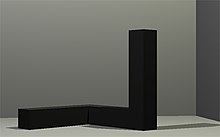
Minimalism in visual art, generally referred to equally "minimal art", "literalist art"[4] and "ABC Art",[5] emerged in New York in the early 1960s as new and older artists moved toward geometric abstraction; exploring via painting in the cases of Nassos Daphnis, Frank Stella, Kenneth Noland, Al Held, Ellsworth Kelly, Robert Ryman and others; and sculpture in the works of various artists including David Smith and Anthony Caro. Judd's sculpture was showcased in 1964 at Green Gallery in Manhattan, as were Flavin'south showtime fluorescent calorie-free works, while other leading Manhattan galleries like Leo Castelli Gallery and Pace Gallery also began to showcase artists focused on geometric brainchild.

In a more broad and general sense, one finds European roots of minimalism in the geometric abstractions of painters associated with the Bauhaus, in the works of Kazimir Malevich, Piet Mondrian and other artists associated with the De Stijl movement, and the Russian Constructivist motion, and in the piece of work of the Romanian sculptor Constantin Brâncuși.[six] [seven]
Minimal art is too inspired in office by the paintings of Barnett Newman, Advert Reinhardt, Josef Albers, and the works of artists equally various as Pablo Picasso, Marcel Duchamp, Giorgio Morandi, and others. Minimalism was likewise a reaction against the painterly subjectivity of Abstract Expressionism that had been dominant in the New York School during the 1940s and 1950s.[8]
Yves Klein had painted monochromes as early equally 1949, and held the outset private exhibition of this work in 1950—just his first public showing was the publication of the Creative person's book Yves: Peintures in November 1954.[nine] [10]
Blueprint, architecture, and spaces [edit]
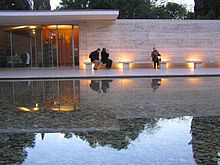
The term minimalism is also used to depict a trend in pattern and architecture, wherein the subject is reduced to its necessary elements.[ citation needed ] Minimalist architectural designers focus on the connection betwixt ii perfect planes, elegant lighting, and the void spaces left by the removal of three-dimensional shapes in an architectural design.[ according to whom? ] [ commendation needed ] Minimalist architecture became pop in the late 1980s in London and New York,[xi] where architects and fashion designers worked together in the boutiques to achieve simplicity, using white elements, cold lighting, and large space with minimum objects and article of furniture.
Minimalistic design has been highly influenced by Japanese traditional design and architecture.[ commendation needed ] The works of De Stijl artists are a major reference: De Stijl expanded the ideas of expression by meticulously organizing bones elements such as lines and planes.[ citation needed ] With regard to home design, more attractive "minimalistic" designs are not truly minimalistic because they are larger, and utilise more than expensive building materials and finishes.[ citation needed ]
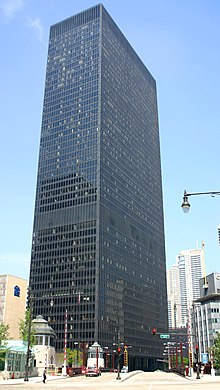
In that location are observers who describe the emergence of minimalism as a response to the brashness and anarchy of urban life. In Japan, for instance, minimalist architecture began to gain traction in the 1980s when its cities experienced rapid expansion and booming population. The design was considered an antitoxin to the "overpowering presence of traffic, advertising, jumbled building scales, and imposing roadways."[12] The chaotic surroundings was not simply driven by urbanization, industrialization, and technology merely besides the Japanese experience of constantly having to demolish structures on business relationship of the destruction wrought past Globe War II and the earthquakes, including the calamities it entails such as burn. The minimalist design philosophy did not arrive in Japan by way of another country every bit it was already function of the Japanese culture rooted on the Zen philosophy. There are those who specifically aspect the design movement to Nihon'southward spirituality and view of nature.[13]
Architect Ludwig Mies van der Rohe (1886–1969) adopted the motto "Less is more" to describe his aesthetic.[a] His tactic was one of arranging the necessary components of a edifice to create an impression of extreme simplicity—he enlisted every element and detail to serve multiple visual and functional purposes; for instance, designing a flooring to also serve as the radiator, or a massive fireplace to also house the bathroom. Designer Buckminster Fuller (1895–1983) adopted the engineer'southward goal of "Doing more than with less", but his concerns were oriented toward technology and engineering science rather than aesthetics.[14]
Concepts and design elements [edit]
The concept of minimalist architecture is to strip everything down to its essential quality and achieve simplicity.[xv] The idea is not completely without ornamentation,[16] but that all parts, details, and joinery are considered equally reduced to a stage where no one can remove annihilation further to better the design.[17]
The considerations for 'essences' are light, form, detail of textile, space, identify, and homo condition.[18] Minimalist architects not only consider the concrete qualities of the edifice. They consider the spiritual dimension and the invisible, by listening to the figure and paying attention to details, people, space, nature, and materials.,[nineteen] assertive this reveals the abstruse quality of something that is invisible and aids the search for the essence of those invisible qualities—such as natural calorie-free, sky, globe, and air. In addition, they "open a dialogue" with the surrounding environment to decide the most essential materials for the construction and create relationships betwixt buildings and sites.[xvi]
In minimalist architecture, design elements strive to convey the bulletin of simplicity. The bones geometric forms, elements without ornament, simple materials and the repetitions of structures represent a sense of social club and essential quality.[xx] The motility of natural lite in buildings reveals simple and make clean spaces.[18] In the late 19th century equally the arts and crafts move became pop in Britain, people valued the attitude of 'truth to materials' with respect to the profound and innate characteristics of materials.[21] Minimalist architects humbly 'mind to figure,' seeking essence and simplicity past rediscovering the valuable qualities in elementary and common materials.[19]
Influences from Japanese tradition [edit]

Ryōan-ji dry out garden. The dirt wall, which is stained by age with subtle brown and orangish tones, reflects "wabi" and the rock garden "sabi", together reflecting the Japanese worldview or artful of "wabi-sabi".[22]
The idea of simplicity appears in many cultures, specially the Japanese traditional culture of Zen Philosophy. Japanese manipulate the Zen culture into aesthetic and design elements for their buildings.[23] This idea of architecture has influenced Western Society, particularly in America since the mid 18th century.[24] Moreover, it inspired the minimalist architecture in the 19th century.[17]
Zen concepts of simplicity transmit the ideas of freedom and essence of living.[17] Simplicity is not only artful value, information technology has a moral perception that looks into the nature of truth and reveals the inner qualities and essence of materials and objects.[25] For case, the sand garden in Ryoanji temple demonstrates the concepts of simplicity and the essentiality from the considered setting of a few stones and a huge empty infinite.[26]
The Japanese aesthetic principle of Ma refers to empty or open space. Information technology removes all the unnecessary internal walls and opens up the space. The emptiness of spatial arrangement reduces everything down to the most essential quality.[27]
The Japanese artful of wabi-sabi values the quality of simple and apparently objects.[28] Information technology appreciates the absence of unnecessary features, treasures a life in quietness and aims to reveal the innate character of materials.[29] For case, the Japanese floral art, also known as Ikebana, has the central principle of letting the flower limited itself. People cut off the branches, leaves and blossoms from the plants and only retain the essential function of the plant. This conveys the idea of essential quality and innate character in nature.[thirty]
Minimalist architects and their works [edit]
The Japanese minimalist architect Tadao Ando conveys the Japanese traditional spirit and his ain perception of nature in his works. His design concepts are materials, pure geometry and nature. He usually uses concrete or natural woods and basic structural form to achieve austerity and rays of light in space. He too sets upwards dialogue betwixt the site and nature to create human relationship and order with the buildings.[31] Ando'south works and the translation of Japanese aesthetic principles are highly influential on Japanese architecture.[13]
Another Japanese minimalist architect, Kazuyo Sejima, works on her own and in conjunction with Ryue Nishizawa, every bit SANAA, producing iconic Japanese Minimalist buildings. Credited with creating and influencing a particular genre of Japanese Minimalism,[32] Sejimas delicate, intelligent designs may use white color, thin construction sections and transparent elements to create the astounding building type often associated with minimalism. Works include New Museum (2010) New York City, Modest House (2000) Tokyo, House surrounded By Plum Trees (2003) Tokyo.
In Vitra Conference Pavilion, Weil am Rhein, 1993, the concepts are to bring together the relationships between edifice, human movement, site and nature. Which every bit ane main indicate of minimalism ideology that establish dialogue between the building and site. The building uses the simple forms of circle and rectangle to contrast the filled and void space of the interior and nature. In the antechamber, there is a big landscape window that looks out to the exterior. This achieves the elementary and silence of compages and enhances the lite, wind, time and nature in infinite.[33]
John Pawson is a British minimalist architect; his pattern concepts are soul, light, and lodge. He believes that though reduced clutter and simplification of the interior to a bespeak that gets beyond the thought of essential quality, in that location is a sense of clarity and richness of simplicity instead of emptiness. The materials in his design reveal the perception toward space, surface, and book. Moreover, he likes to utilise natural materials because of their aliveness, sense of depth and quality of an individual. He is as well attracted by the important influences from Japanese Zen Philosophy.[34]
Calvin Klein Madison Avenue, New York, 1995–96, is a bazaar that conveys Calvin Klein'due south ideas of mode. John Pawson's interior design concepts for this project are to create unproblematic, peaceful and orderly spatial arrangements. He used rock floors and white walls to achieve simplicity and harmony for space. He also emphasises reduction and eliminates the visual distortions, such as the air conditioning and lamps to attain a sense of purity for interior.[35]
Alberto Campo Baeza is a Spanish architect and describes his work as essential architecture. He values the concepts of lite, idea and space. Light is essential and achieves the relationship between inhabitants and the building. Ideas are to meet the function and context of space, forms, and structure. Space is shaped by the minimal geometric forms to avoid ornament that is non essential.[36]
Literature [edit]
Literary minimalism is characterized past an economy with words and a focus on surface description. Minimalist writers eschew adverbs and adopt allowing context to dictate meaning. Readers are expected to take an active part in creating the story, to "choose sides" based on oblique hints and innuendo, rather than react to directions from the writer.[ citation needed ]
Some 1940s-era law-breaking fiction of writers such as James M. Cain and Jim Thompson adopted a stripped-down, matter-of-fact prose style to considerable outcome; some[ who? ] allocate this prose way equally minimalism.
Some other strand of literary minimalism arose in response to the metafiction tendency of the 1960s and early 1970s (John Barth, Robert Coover, and William H. Gass). These writers were also sparse with prose and kept a psychological altitude from their subject field matter.[ commendation needed ]
Minimalist writers, or those who are identified with minimalism during certain periods of their writing careers, include the following: Raymond Carver,[37] Ann Beattie, Bret Easton Ellis, Charles Bukowski, Ernest Hemingway, K. J. Stevens, Amy Hempel, Bobbie Ann Mason, Tobias Wolff, Grace Paley, Sandra Cisneros, Mary Robison, Frederick Barthelme, Richard Ford, Patrick Holland, Cormac McCarthy, and Alicia Erian.[ commendation needed ]
American poets such as Stephen Crane, William Carlos Williams, early Ezra Pound, Robert Creeley, Robert Grenier, and Aram Saroyan are sometimes identified with their minimalist style. The term "minimalism" is as well sometimes associated with the briefest of poetic genres, haiku, which originated in Japan, only has been domesticated in English literature past poets such every bit Nick Virgilio, Raymond Roseliep, and George Swede.[ citation needed ]
The Irish writer Samuel Beckett is well known for his minimalist plays and prose, as is the Norwegian author Jon Fosse.[38]
Dimitris Lyacos's With the People from the Span, combining elliptical monologues with a pared-down prose narrative is a contemporary example of minimalist playwrighting.[39] [40]
In his novel The Like shooting fish in a barrel Concatenation, Evan Dara includes a 60-folio section written in the style of musical minimalism, in particular inspired past composer Steve Reich. Intending to represent the psychological state (agitation) of the novel's chief character, the department's successive lines of text are built on repetitive and developing phrases.[ commendation needed ]
Music [edit]
The term "minimal music" was derived around 1970 past Michael Nyman from the concept of minimalism, which was earlier applied to the visual arts.[41] [42] More precisely, it was in a 1968 review in The Spectator that Nyman offset used the term, to describe a 10-infinitesimal piano composition by the Danish composer Henning Christiansen, along with several other unnamed pieces played by Charlotte Moorman and Nam June Paik at the Establish of Contemporary Arts in London.[43]
Even so, the roots of minimal music are older. In France between 1947 and 1948,[44] Yves Klein conceived his Monotone Symphony (1949, formally The Monotone-Silence Symphony) that consisted of a single twenty-minute sustained chord followed by a xx-minute silence[45] [46] – a precedent to both La Monte Young'south drone music and John Cage'due south 4′33″.
Picture and movie theatre [edit]
In picture, minimalism ordinarily is associated with filmmakers such every bit Robert Bresson, Carl Theodor Dreyer, and Yasujirō Ozu. Their films typically tell a simple story with straightforward camera usage and minimal employ of score. Paul Schrader named their kind of picture palace: "transcendental picture palace".[47] In the present, a delivery to minimalist filmmaking tin can exist seen in low-budget movie movements such as Dogme 95 and mumblecore. Abbas Kiarostami[48] and Elia Suleiman are also considered creators of minimalistic films.[49]
The Minimalists – Joshua Fields Millburn, Ryan Nicodemus, and Matt D'Avella – directed and produced the picture Minimalism: A Documentary,[50] which showcased the thought of minimal living in the modern world.
Software and UI design [edit]
In software and user interface blueprint, minimalism describes the usage of fewer design elements, flat design, fewer options and features, and tendentially less occupied screen space.
Examples [edit]
- Galaxy S6
One example is the user interface of the Samsung Galaxy S6,[51] where many options and items from menus and settings were pruned.
- Samsung 2015 stand-by carte
The update to Android Lollipop removed the shortcuts to "Silent", "Vibration simply", and "Sound on" in the stand-by menu.[52]
- iOS 7 and Android Lollipop update
The Android Lollipop update (tardily 2014–2015) applied to both stock Android and TouchWiz UI devices changes the appearance of the user interface, specially the setting menus[53] of which the apply of icons, edge lines, edges, and contrast elements take been reduced to a minimum. Furthermore, the remaining icons take become less skeumorphistic and more abstract, adapting to flat blueprint language. The density of the elements on the user interface has decreased. There is more than whitespace, or unoccupied screen space. Similar changes happened with the update from iOS six to iOS seven.
- Context bill of fare icons
In 2014, the icons from context menus of Samsung'south TouchWiz applications (Samsung Gallery, S Browser, telephone app, etc.) were pruned.
- Unavailable options
Prior to Samsung's TouchWiz Nature UX 3.0, carte du jour options that are currently unavailable (e.g. "Search for text in page" in the Cyberspace browser during a page load) were shown, merely grayed out, which has the advantage of informing the user virtually their existence but that the option is unavailable. Since then, unavailable options are hidden completely, which makes the context menu occupy less screen infinite, but it might cause the user to non realize immediately that the feature is unavailable.
- Browser'due south URL bar only shows domain name
Started in Safari browser for iOS and adapted past Samsung'south "S Browser",[55] some browsers only prove the domain name instead of the full URL, even if there is spare space in the URL bar.
- Instagram website redesign
In June 2015, the layout of Instagram'due south website was fully redesigned to resemble the mobile awarding and mobile website, pruning many user interface elements, for example, the slideshow banner.
- Skype blueprint overhaul
Another example is the Skype redesign[ when? ], where many icons from context menus were removed, color gradients were replaced with flat colors, and the density of user interface elements was decreased.
In other fields [edit]
Cooking [edit]
Breaking from the complex, hearty dishes established as orthodox haute cuisine, nouvelle cuisine was a culinary movement that consciously drew from minimalism and conceptualism. It emphasized more bones flavors, careful presentation, and a less involved preparation process. The motility was mainly in vogue during the 1960s and 1970s, later which it one time once more gave mode to more traditional haute cuisine, retroactively titled cuisine classique. Withal, the influence of nouvelle cuisine can still be felt through the techniques it introduced.[56]
Way [edit]
The capsule wardrobe is an example of minimalism in fashion. Constructed of only a few staple pieces that practice non go out of style, and generally dominated by only one or two colors, sheathing wardrobes are meant to be low-cal, flexible and adaptable, and can be paired with seasonal pieces when the situation calls for them.[57] The modern thought of a capsule wardrobe dates back to the 1970s, and is credited to London boutique owner Susie Faux. The concept was further popularized in the side by side decade past American fashion designer Donna Karan, who designed a seminal drove of sheathing workwear pieces in 1985.[58]
Science communication [edit]

To portray global warming to not-scientists, in 2018 British climate scientist Ed Hawkins adult warming stripes graphics that are deliberately devoid of scientific or technical indicia.[threescore] Hawkins explained that "our visual organization volition practice the estimation of the stripes without us even thinking about it".[61]
Warming stripe graphics resemble color field paintings in stripping out all distractions and using but color to convey meaning.[62] Color field pioneer artist Barnett Newman said he was "creating images whose reality is self-axiomatic", an ethos that Hawkins is said to have applied to the problem of climate change and leading one commentator to remark that the graphics are "fit for the Museum of Modern Art or the Getty."[62]
See also [edit]
- Formalism (fine art)
- Osculation principle
- Lyrical brainchild
- Neo-minimalism
- Maximalism
- Minimalism (computing)
- Simple living
- List of minimalist artists
Notes and references [edit]
Notes [edit]
- ^ See Johnson 1947. A like sentiment was conveyed by industrial designer Dieter Rams' motto, "Less but better."
References [edit]
- ^ "Christopher Want, Minimalism, Grove Fine art Online, Oxford University Press, 2009". Moma.org. Retrieved 2014-06-27 .
- ^ "Minimalism". theartstory.org. 2012.
- ^ "Minimalism". Encyclopædia Britannica.
- ^ Fried, Michael (June 1967). "Fine art and Objecthood". Artforum. Vol. five. pp. 12–23. Reprinted: "Fine art and Objecthood". Art and Objecthood: Essays and Reviews. Academy of Chicago Press. 1998. pp. 148–172. ISBN0-226-26318-5.
- ^ Rose, Barbara. "ABC Fine art", Art in America 53, no. 5 (Oct–November 1965): 57–69.
- ^ "Maureen Mullarkey, Art Disquisitional, Giorgio Morandi". Artcritical.com. Oct 2004. Retrieved 2014-06-27 .
- ^ Marzona, Daniel (2004). Daniel Marzona, Uta Grosenick; Minimal art, p.12. ISBN9783822830604 . Retrieved 2014-06-27 .
- ^ Battcock, Gregory (three August 1995). Gregory Battcock, Minimal Art: a critical album, pp 161–172. ISBN9780520201477 . Retrieved 2014-06-27 .
- ^ Hannah Weitemeier, Yves Klein, 1928–1962: International Klein Blue, Original-Ausgabe (Cologne: Taschen, 1994), 15. ISBN three-8228-8950-4.
- ^ "Restoring the Immaterial: Study and Treatment of Yves Klein'due south Blue Monochrome (IKB42)". Mod Paint Uncovered.
- ^ Cerver 1997, pp. 8–11.
- ^ Ostwald, Michael; Vaughan, Josephine (2016). The Fractal Dimension of Compages. Mathematics and the Congenital Surroundings. Cham, Switzerland: Birkhäuser; Springer International Publishing. p. 316. ISBN9783319324241.
- ^ a b Cerver 1997, p. 13.
- ^ Johnson 1947, p. 49.
- ^ Bertoni 2002, p. 10.
- ^ a b Rossell 2005, p. half-dozen
- ^ a b c Pawson 1996, p. 7
- ^ a b Bertoni 2002, pp. fifteen–xvi
- ^ a b Bertoni 2002, p. 21
- ^ Pawson 1996, p. 8.
- ^ Saito 2007, pp. 87–88.
- ^ 森神逍遥 『侘び然び幽玄のこころ』桜の花出版、2015年 Morigami Shouyo, " Wabi sabi yugen no kokoro: seiyo tetsugaku o koeru joi ishiki " (Japanese) ISBN 978-4434201424
- ^ Saito 2007, pp. 85–97.
- ^ Lancaster 1953, pp. 217–224.
- ^ Saito 2007, p. 87.
- ^ Pawson 1996, p. 98.
- ^ Bertoni 2002, p. 23.
- ^ Saito 2007, p. 85.
- ^ Pawson 1996, pp. 10–11.
- ^ Saito 2007, p. 86.
- ^ Bertoni 2002, pp. 96–106.
- ^ Puglisi, L. P. (2008), New Directions in Contermporary Architecture, Chichester, John Wiley and Sons.
- ^ Cerver 1997, pp. 18–29.
- ^ Pawson 1996, pp. 10–14.
- ^ Cerver 1997, pp. 170–177.
- ^ Bertoni 2002, p. 182.
- ^ Wiegand, David (2009-12-nineteen). "Serendipitous stay led writer to Raymond Carver". San Francisco Chronicle . Retrieved 2022-03-31 .
{{cite spider web}}: CS1 maint: url-status (link) - ^ Davies, Paul. "Samuel Beckett". Literary Encyclopedia . Retrieved 2 Dec 2016.
- ^ "From the Ruins of Europe: Lyacos's Debt-Riddled Greece" past Joseph Labernik, Tikkun, 21 August 2015
- ^ "The Commonline Journal: Review of Dimitris Lyacos's With the People from the Bridge | Editor Notation past Ada Fetters". Archived from the original on 2015-12-08. Archived 2015-12-08 at the Wayback Machine [ dead link ]
- ^ Bernard, Jonathan W. (Winter 1993). "The Minimalist Aesthetic in the Plastic Arts and in Music". Perspectives of New Music. 31 (1): 87. doi:x.2307/833043. JSTOR 833043. , citing Dan Warburton every bit his authority.
- ^ Warburton, Dan. "A Working Terminology for Minimal Music". Retrieved 11 January 2014.
- ^ Nyman, Michael (11 Oct 1968). "Minimal Music". The Spectator. Vol. 221, no. 7320. pp. 518–519 (519).
- ^ "Yves Klein (1928–1962)". documents/biography. Yves Klein Archives & McDourduff. Archived from the original on 30 May 2013. Retrieved 12 May 2013.
- ^ Gilbert Perlein & Bruno Corà (eds) & al., Yves Klein: Long Live the Immaterial! ("An anthological retrospective", catalog of an exhibition held in 2000), New York: Delano Greenidge, 2000, ISBN 978-0-929445-08-iii, p. 226: "This symphony, 40 minutes in length (in fact xx minutes followed by 20 minutes of silence) is constituted of a single 'audio' stretched out, deprived of its assault and end which creates a sensation of vertigo, whirling the sensibility outside time."
- ^ See also at YvesKleinArchives.org a 1998 sound excerpt of The Monotone Symphony Archived 2008-12-08 at the Wayback Machine (Flash plugin required), its short description Archived 2008-ten-28 at the Wayback Automobile, and Klein's "Chelsea Hotel Manifesto" Archived 2010-06-13 at the Wayback Car (including a summary of the 2-part Symphony).
- ^ Paul Schrader on Revisiting Transcendental Fashion in Moving-picture show. 2017 Toronto International Film Festival – via YouTube.
- ^ "Gustatory modality of Cherry | Cinematheque". Cleveland Found of Art. September 2016. Retrieved 2022-01-14 .
- ^ Gautaman Bhaskaran (2019-10-23). "It Must Be Heaven: Elia Suleiman's sardonic take on the world". Arab News . Retrieved 2022-01-14 .
- ^ "Films by The Minimalists". The Minimalists . Retrieved 2019-04-09 .
- ^ Hyun Yeul Lee'due south speech on Samsung Galaxy Unpacked 2015 – Episode ane (2015-03-01). Find the excessive usage of marketing buzzwords
- ^ Samsung stand-by menu before and since Android 5.
- ^ Screenshot of Samsung Milky way S4 settings bill of fare with Android 4.4.2 (earlier update) and Android 5.0 (afterward update), reducing border lines and using more than abstruse icons rather than skeumorphs.
- ^ Samsung'south chromium-based Internet browser (Google Play store: "com.sec.android.app.sbrowser").
- ^ Mennel, Stephan. All Manners of Nutrient: eating and taste in England and France from the Middle Ages to the nowadays. 2d ed., (Chicago: University of Illinois Printing, 1996), 163-164.
- ^ Susie, False. "Sheathing Wardrobe". Archived from the original on 4 January 2012. Retrieved 6 Apr 2012.
- ^ "Donna Karan". voguepedia. Faddy. Archived from the original on 14 April 2012. Retrieved 6 April 2012.
- ^ Data: "Land + Ocean (1850 – Recent) / Monthly Global Average Temperature (almanac summary)". Berkeley Earth. 2019. Archived from the original on December 8, 2021. Retrieved July 4, 2019.
- ^ Kahn, Brian (June 17, 2019). "This Striking Climate Alter Visualization Is Now Customizable for Any Identify on Earth". Gizmodo. Archived from the original on June 26, 2019. Retrieved July 10, 2019.
- ^ Staff, Science AF (May 25, 2018). "This Has Got to Exist One of The Virtually Beautiful And Powerful Climate Change Visuals Nosotros've Ever Seen". Science Warning. Archived from the original on June 28, 2019.
- ^ a b Kahn, Brian (May 25, 2018). "This Climate Visualization Belongs in a Damn Museum". Gizmodo. Archived from the original on June nineteen, 2019.
Sources [edit]
- Bertoni, Franco (2002). Minimalist Compages, edited by Franco Cantini, translated from the Italian by Lucinda Byatt and from the Castilian past Paul Hammond. Basel, Boston, and Berlin: Birkhäuser. ISBN three-7643-6642-7.
- Cerver, Francisco Asencio (1997). The Compages of Minimalism. New York: Arco. ISBN0-8230-6149-3.
- Johnson, Philip (1947). Mies van der Rohe. Museum of Modernistic Art.
- Lancaster, Clay (September 1953). "Japanese Buildings in the United states of america before 1900: Their Influence upon American Domestic Architecture". The Art Bulletin. 35 (three): 217–224. doi:10.1080/00043079.1953.11408188.
- Pawson, John (1996). Minimum. London, England: Phaidon Printing. ISBN0-7148-3262-6.
- Rossell, Quim (2005). Minimalist Interiors. New York: Collins Design. ISBN0-688-17487-6.
- Saito, Yuriko (Winter 2007). "The Moral Dimension of Japanese Aesthetics". The Journal of Aesthetics and Fine art Criticism. 65 (1): 85–97. doi:10.1111/j.1540-594X.2007.00240.x.
Further reading [edit]
- Chayka, Kyle (2020). The Longing for Less: Living with Minimalism. New York: Bloomsbury. ISBN9781635572100.
- Keenan, David, and Michael Nyman (4 Feb 2001). "Merits to Frame". Sunday Herald
External links [edit]
-
 Media related to Minimalism at Wikimedia Commons
 - Agence Photographique de la Réunion des musées nationaux et du Grand Palais des Champs-Elysées
- "A Brusque History of Minimalism—Donald Judd, Richard Wollheim, and the origins of what nosotros now draw as minimalist" By Kyle Chayka January 14, 2020 The Nation
Source: https://en.wikipedia.org/wiki/Minimalism
0 Response to "Can Concept Art Be Used to Describe a Video Game"
Post a Comment